Posts

Showing posts with the label silver

The Amen break ring

Image
A set of silver stacking rings featuring the famous "Amen break" More on  the Amen break here . Of course it's relatively simple to apply this technique to any other sound sample. Maybe the Apache break, or Funky Drummer. Or even something which isn't a breakbeat. 

Casting with Delft Clay

Image
A custom request from a lady of excellent taste, asking for a spitfire ring. Challenge accepted! This video shows how to casting a spitfire using the Delft clay casting system. Delft clay is an oilsand designed for fine casts - it's a mixture of sand, clay and oil. The process is fairly straightforward but as you'll see, it's not as failsafe as other casting methods. I got it right second time though!

Melting down old silver

Image
I was given a load of old sterling jewellery to make into something new. The video shows the first stage, to melt it down into useful ingots. Once poured, the ingots need cleaning to remove impurities that have come to the surface. The melt-pour-clean process may need repeating several times. Once clean, the ingots can be recast, or forged/rolled into sheet or wire. Casting video to follow soon.

The Quest for Imperfection, or In Search of Wabi-Sabi

Image
My background is in software, specifically web development. I used to do both front and back end stuff, as well as sysadmin things. I worked with graphic designers a lot, some amazingly skilled people from whom I learned the importance of getting things exactly right, visually. Exactly right. Every pixel has to be perfect, every aspect of a design thought through carefully and then polished to perfection. I'm eternally grateful for the things I learned from those people. Programming and systems admin adds a different dimension to the art of "Doing Stuff Right", that of every case being accounted for and every exception or problem caught before it happens. Beauty takes many forms, both in terms of visual design and in software too. This focus on detail, on perfection, has carried over into my current work in the physical realm. Making stuff that is machine-perfect isn't so hard. Especially when using machines (although I don't have as many machines as I'd li...

Experiments in using solder paste

Image
Generally when joining metal I use sheet solder, which is economical and in most cases, easy and fast to use. But sometimes it can be a pain to get solder in place around a particularly tiny piece, so I thought I'd have a go with silver solder paste  instead. It's a bit more expensive but it lasts for ages. I'm starting out with a plain silver ring , to which I'm going to solder some silver and copper blobs. Blobby blobby blobby! OK, right. Here we go. Excuse my fingernails, I've been testing out gilding nails with copper leaf. It actually worked pretty well, this is a few days afterwards.. Dot punch to start with. Stops the drill skipping off the surface of the ring. Bzzzzzzzz. Only drill a bit into the surface, don't go all the way through. Repeat until lots of holes. This is fine silver casting grain, usually used for melting down prior to turning into other exciting stuff , but this shape is exactly what I want for this ring. Carefull...

A Short Gilding Tutorial

Image
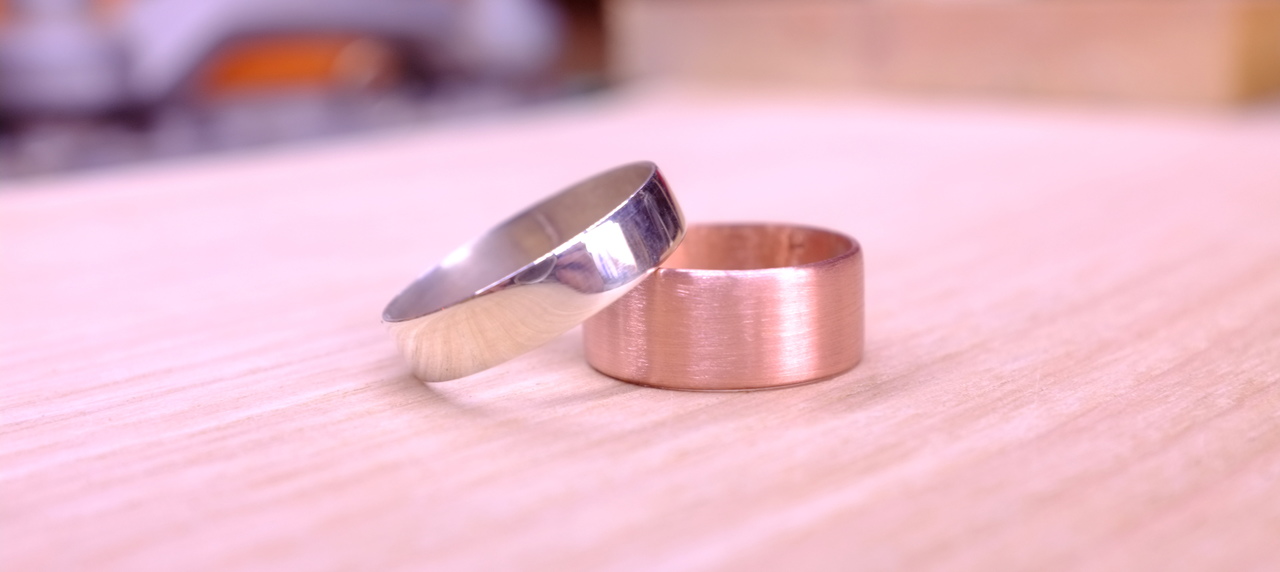
As requested by someone on Reddit's wonderful /r/crafts subreddit, a short tutorial on gilding. Gilding is not as hard as you might expect, and with a simple beginner's kit , you can get going right away. I suggest purchasing an imitation leaf kit to start with, as messing up gilding aluminium is an awful lot cheaper than messing up with 24k gold leaf! OK, so here are a pair of rings waiting to be gilded. They were made as per the tutorial on making metal rings I did last week. One silver, one copper. One bright and mirror polished, one satin finish. They need to be clean, so no finishing polish or wax just yet. I'm going to use two different gilds on these, in two different styles - but your options are limited only by your skills with a brush and your imagination. Gilding, being an ancient art, has lots of lovely old language associated with it. Gilders don't use glue, they use size. It's basically just glue. I like to use a nice fine lining...

How to Make a Wire-Inlaid Wooden Necklace

Image
I know in my last post I said I'd do some epoxy inlay stuff, but I just finished a run of epoxy inlay and have been doing some wire inlays recently instead. So, wire inlay it is today, epoxy inlays another time. A simple wire inlay on a carefully chosen piece of wood can create a beautiful piece of jewellery which will last for years. This tutorial will cover a very simple, single wire inlay, but the principles for doing more complex things are the same. First up, choose some wood. Lets assume we've gone through the standard rough-cut, shaping, sanding montage and go straight to selecting from some wooden pendant blanks. Left to right I have Purpleheart, Padouk, Douglas Fir, more Purpleheart and the one I've chosen, a piece of American Black Walnut. It doesn't look too jazzy now, but when we're done it'll be really nice. Walnut is quite an understated wood, but it's definitely got class. So, first things first - mark where you want your inlay to g...